
Home › Residential Concrete Contractor
Residential concrete · Greater Houston
Residential Concrete Contractor in Houston
Quick answer
We pour driveways, patios, walkways, garage floors, RV pads and accessory slabs for homes across Houston. Most residential jobs take 2–5 working days on site. Broom-finish driveways run $8–$14 per sq ft and patios $7–$12 per sq ft; garage floor replacement runs $10–$16 per sq ft with tear-out. You get an itemized written estimate.
Get a typical Houston price range in under a minute.
Add your name, a 10-digit phone, a valid email and a 5-digit ZIP.
Planning range from typical Houston pricing. Your written, itemized estimate after an on-site measure is the number we work from.
Got it. We call back the same business day (Mon–Fri, 8am–5pm).
Call or text (512) 749-7448Residential Concrete Services
Concrete Driveways
A new driveway is a 4-inch reinforced slab with a broom finish, sloped to the street. A two-car replacement takes about 3 days. Work on the approach in the public right-of-way goes through City of Houston permits.
Concrete Patios
A 16 × 20 ft backyard slab fits a dining table and a grill. We set the fall away from the house at about 1/4 inch per foot.
House Foundations and Accessory Slabs
Slabs for detached garages, sheds, workshops and room additions run $7–$12 per sq ft with a vapor barrier. A full house foundation is a post-tension slab, and we price it from your engineer's stamped plans rather than a per-foot figure.
Sidewalks and Walkways
Front walks and side-yard paths are typically 4 inches thick and 3–5 ft wide, with tooled joints every 4–5 ft so cracks stay in the grooves.
Stamped and Decorative Concrete
Stamped, colored and exposed-aggregate finishes. Decorative driveways run $12–$20 per sq ft.
Garage Floors, RV Pads and Replacement
We break out sunken or cracked garage floors and pour new ones in about 4 days. RV and boat pads are thickened to 6 inches with heavier steel. Full tear-out and replacement of any old slab adds $2–$6 per sq ft for demolition and haul-off.
Post-Tension or Rebar: Which Slab Fits Houston Clay?
Use post-tension for a house foundation and rebar for driveways, patios and most accessory slabs. Both answer the same problem: Beaumont clay swells when the fall rains arrive and shrinks hard in an August drought, lifting and dropping a slab by fractions of an inch every year.
A post-tension slab has steel cables run through it and stretched with a hydraulic jack 3–10 days after the pour. The slab then acts as one stiff plate over moving clay. Grade beams and cable layout come from an engineer's soil report.
A rebar slab carries a grid of #3 or #4 bars at 12–18 inches, held mid-depth on chairs. It cannot stop the clay from moving, so control joints decide where the slab cracks. On flatwork we cut joints every 8–10 ft and undercut soft gumbo down to firm soil before placing base.
| Factor | Post-tension slab | Rebar slab |
|---|---|---|
| Typical use | House foundations, large additions | Driveways, patios, garage and shed slabs |
| Design | Engineer, from a soil report | Typical specs below unless plans say otherwise |
| Steel | Tensioned cables plus grade beams | #3–#4 bars, 12–18 in grid |
| Pricing | Quoted from plans | $7–$12 / sq ft for a standard slab |
Typical residential specs: 3,000–4,000 PSI concrete, 4 inches for walks, patios and car driveways, 6 inches for RV pads and drives that see trucks. Those figures are typical ranges, and your engineer's plans govern when a project has them.
Built for Houston
Built for Houston Yards
Residential lots here are flat, so a slab has to make its own drainage. Many 1960s–1980s driveways were poured almost level and now hold a puddle at the garage door after every storm. We shoot grades with a laser before forming and build in at least 1/8 inch of fall per foot toward the street or a yard drain.
Tree roots are the second issue. Live oaks planted along the front of older lots push up walks and driveway corners within 15–20 years. Where roots are close, we cut them back at the slab edge only after you approve it, and we add a root barrier strip along the form line.
Our summer trucks arrive around sunrise. By early afternoon in July, slab surfaces can dry faster than the concrete below can cure, which leaves a weak, dusty top layer. We spray a curing compound right after finishing. When a tropical storm is in the forecast inside 48 hours, we move the pour date.
Typical Houston project
Before & After: Typical Houston Project
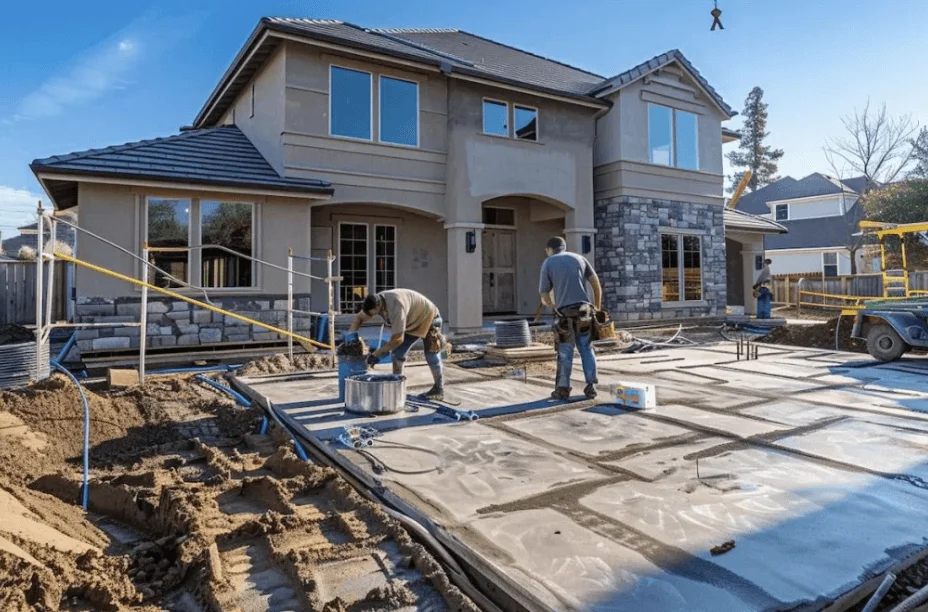
Typical project, Westbury: a 1970s 20 × 20 ft driveway with a heaved corner and a ponding low spot at the garage. Tear-out and haul-off, soft clay undercut and replaced, new 4-inch slab on #3 rebar at 16 inches with a corrected slope. Three working days on site. Typical cost: $4,000–$8,000.
Our Residential Process
Site visit
we measure, check drainage, trees and truck access, and tell you in the estimate whether your project needs a permit or HOA architectural review.
Written estimate
slab size, thickness, steel, joint layout, tear-out and payment schedule each on its own line.
Prep day
demolition, grading, compacted base, forms and steel set on chairs. You can look it over before the truck arrives.
Pour day
concrete placed, finished and cured with compound; joints saw-cut within 24 hours.
Walkthrough
we walk the finished slab with you and leave written cure and care instructions, including the date you can drive on it.
Cost
How Much Does Residential Concrete Cost in Houston?
Most residential flatwork in Houston costs $7–$12 per sq ft installed; decorative, thickened and replacement work costs more. Typical Houston ranges:
| Job | Per sq ft | Example | Example total |
|---|---|---|---|
| Driveway, broom finish | $8–$14 | 20 × 20 ft (400 sq ft) | $3,200–$5,600 |
| Driveway, stamped or colored | $12–$20 | 20 × 20 ft (400 sq ft) | $4,800–$8,000 |
| Patio, standard slab | $7–$12 | 16 × 20 ft (320 sq ft) | $2,250–$3,850 |
| Sidewalk or walkway | $7–$12 | 4 × 40 ft (160 sq ft) | $1,100–$1,900 |
| Shed or garage slab | $7–$12 | 12 × 16 ft (192 sq ft) | $1,350–$2,300 |
| Garage floor replacement | $10–$16 | 20 × 22 ft (440 sq ft) | $4,400–$7,050 |
| RV pad, 6 in | $10–$17 | 12 × 40 ft (480 sq ft) | $4,800–$8,150 |
| House foundation | Quoted from plans | — | — |
Why Houston Homeowners Choose Us
Residential Service Area
Full coverage is listed on our Houston service area page.
How much does a concrete driveway cost in Houston?
A broom-finish concrete driveway in Houston typically costs $8–$14 per sq ft, or about $3,200–$5,600 for a 20 × 20 ft slab. Tear-out of an old driveway adds $2–$6 per sq ft.
Post-tension or rebar slab for Houston clay?
Post-tension is the standard for house foundations on Houston clay, and rebar is the standard for driveways, patios and small slabs. A post-tension design comes from an engineer and a soil report.
How long until I can drive on new concrete?
Wait 7 days before driving a car on new concrete, and about 28 days before parking an RV or heavy truck on it. Foot traffic is fine after 24–48 hours.
Why does residential concrete crack in Houston?
Concrete cracks in Houston mostly because expansive clay under the slab swells after rain and shrinks in drought. Saw-cut control joints, a firm base and rebar keep those cracks in planned lines.
Do I need a permit to pour a driveway in Houston?
Often yes: a new or widened driveway approach in the City of Houston right-of-way needs a city permit. Rules differ in suburb cities and HOA communities, so we tell you in the estimate whether your project needs a permit.
How thick should a residential slab be?
A residential slab is typically 4 inches thick for patios, walks and car driveways, and 6 inches for RV pads or truck drives, and your engineer's plans govern when a project has them.
Request a Residential Estimate
Run the calculator for a typical range, or send us your project with a photo and rough measurements. Expect an answer the same business day. Larger property work is handled by our commercial concrete crew, and all services are on our homepage.
Mon–Fri, 8 am–5 pm · Same-business-day reply
Prefer to Message Us?
We reply the same business day, Monday–Friday.